
City of Milford Arrest Records and Charges
An arrest record starts with law enforcement. In Milford, police may create reports, incident records, local criminal record check results, arrest paperwork, and booking-related records. The official Milford Police page lists a 24-hour department, a records phone line, and forms for public records requests, report requests, accident reports, parking ticket appeals, identity theft packets, bad check packets, complaints, and traffic forms. Those police records are requested through police channels, not the court clerk.
Court charge records begin when the State's Attorney files or proceeds on accusations in court after police referral, arrest, summons, or warrant activity. Connecticut calls the prosecutor the State's Attorney, not District Attorney. The Ansonia-Milford State's Attorney's office prosecutes criminal offenses in the judicial district, while the clerk maintains the court file and docket. The filed charge then appears through pending case, daily docket, docket-number, or conviction search paths if it is public.
The custody or jail side is separate. Connecticut does not operate local county jails for Milford, and DOC custody information is searched statewide. Booking and custody questions fit the City of Milford inmate records path, while the full case outcome belongs in the City of Milford criminal court records file.
Milford Arrest Records Request Channels
Police records use local channels first. The Milford Police Department is at 430 Boston Post Road and operates 24 hours a day, 7 days a week. The main phone is 203-878-6551, and the records phone is 203-874-4615 for reports, records, and availability checks. The Police FAQ states that a local criminal record check is limited to records for the City of Milford and requires a $10 check or money order when submitted as described by the city.
The Milford Police forms page lists public records requests and report request links.
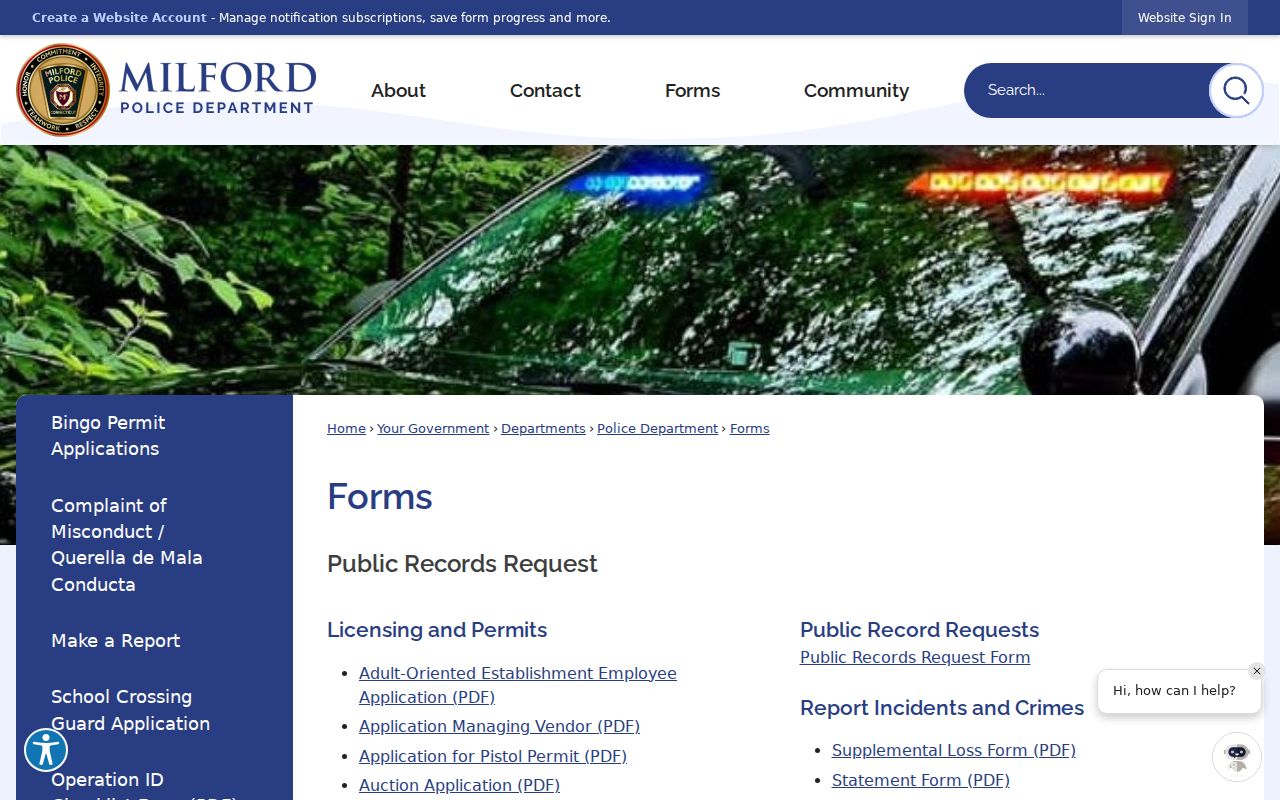
This forms page is the local starting point when the needed record is a police report, accident report, parking appeal, or other department record rather than the filed court charge.
The Milford Police GovQA records request portal is linked from official police forms for public records and report requests.
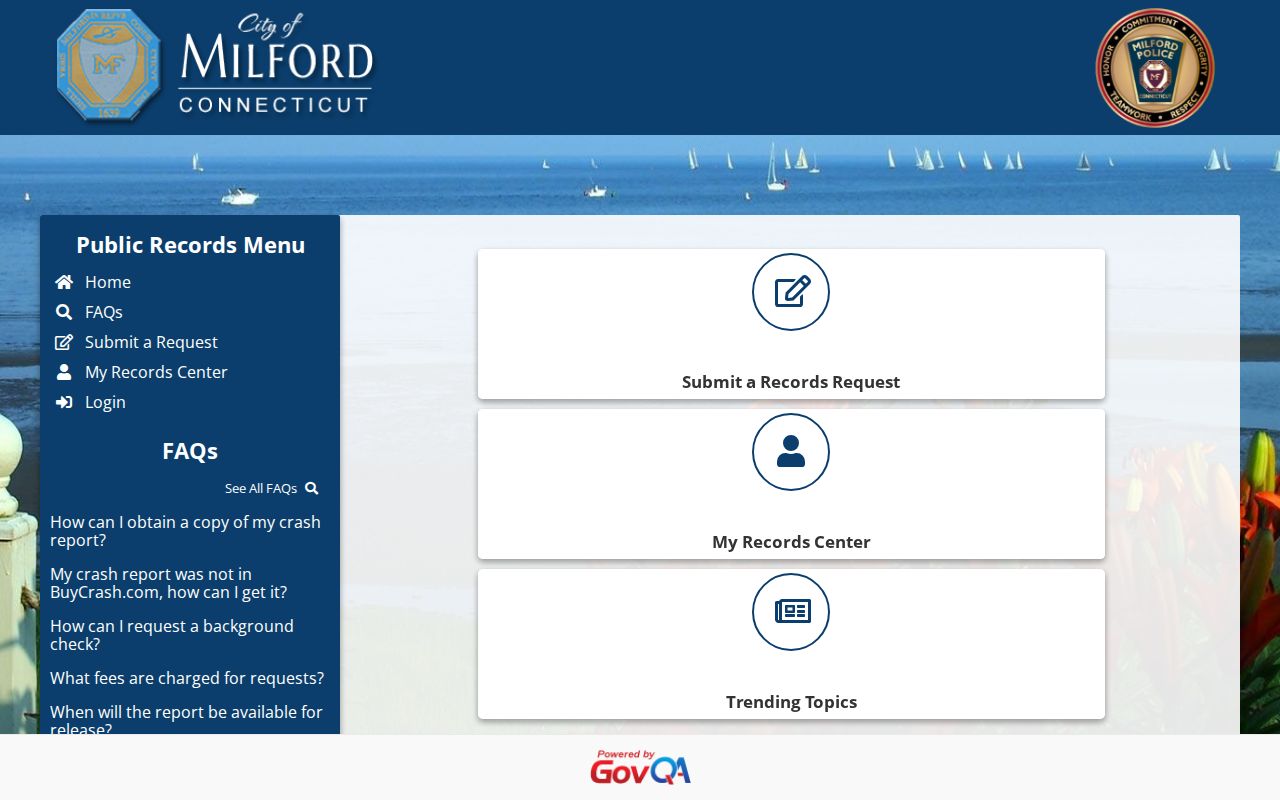
Use the portal for police records requests, then use the Judicial Branch criminal lookup if the question is whether charges were filed in court.
Milford also has a non-police FOIA form for city agency records, but police records and court records are routed differently. Connecticut FOIA can apply to administrative records, while court files depend on Judicial Branch rules, sealing orders, erasure law, and clerk access procedures. That split is important for arrest records because a single event can create a police report, a local records check entry, a court docket, and later a DOC custody entry if the person is held.
Court Charges After Arrest
After an arrest or police referral, the prosecutor reviews the facts and decides what charges to pursue. The court charge record can list one count or several counts, and those counts can change as a case moves. In Milford matters, the relevant court locations include Milford Geographical Area 22 and the Milford Judicial District. Searchers should not assume the first arrest label is the final court charge.
The Connecticut Judicial Branch criminal and motor vehicle lookup menu provides separate paths for pending cases, convictions, daily dockets, docket-number lookups, motions to seal, and warrants. Pending case search is useful for accusations before final disposition. Conviction search is narrower and generally shows charges that resulted in conviction within the public display period.
- Start with the police records path if the request is for a Milford arrest report or local criminal check.
- Open the Judicial Branch criminal and motor vehicle lookup menu for filed court charges.
- Use pending case search by defendant when the case is active and the docket number is unknown.
- Use docket-number search when the court code, case type, year, docket number, and suffix are known.
- Check conviction search only after final disposition, and remember the 10-year display limit.
Charging Documents in Milford Cases
Research for Milford identifies the prosecutor's role and the court charge record, but it does not provide a local form inventory for every charging document type. The practical distinction is still important: a police arrest record describes law enforcement action, while the filed court charge is the accusation that the court tracks. The charging document or court entry is what makes the charge part of the court case file.
| Document or Entry | Who Uses It | What It Does |
|---|---|---|
| Complaint or arresting charge | Police and prosecutor path | Connects the arrest or summons to the accusation that starts court processing. |
| Information or substituted charge | State's Attorney | States the formal count the prosecutor proceeds on in Superior Court. |
| Indictment | Grand jury process where applicable | Used for the most serious matters in systems that require grand jury charging. |
For Milford users, the most reliable public path is not the label on the form. It is the court docket and charge status shown through the Judicial Branch pending, daily docket, docket-number, or conviction tools.
City of Milford Charge Status
Charge status tells what happened to each count. A person can be arrested on several allegations, but the court may end with fewer counts, different counts, a nolle, a dismissal, a plea, or a trial result. Connecticut's glossary in the research identifies disposition as the final result of a charge or case, and nolle as a prosecutor's decision not to proceed, subject to Connecticut rules.
| Status | What It Means in a Court Charge Record |
|---|---|
| Pending | The accusation remains active and has not reached a final court result. |
| Amended or reduced | The filed charge changed during prosecution, plea discussions, or court proceedings. |
| Dismissed | The court ended the count without a conviction. |
| Nolle | The prosecutor chose not to proceed on the charge, subject to Connecticut rules and timing. |
| Convicted | A guilty plea, verdict, or qualifying motor vehicle forfeiture resulted in a conviction entry. |
Note: One docket can contain more than one charge, so each count should be read separately before drawing a conclusion.
Charges vs Convictions
A charge is an accusation. A conviction is a final court result. Connecticut's public conviction lookup displays each criminal and motor vehicle charge that resulted in conviction within the display period, but it does not show youthful offender cases, juvenile cases, or infraction and violation convictions. Pending search, daily docket search, and police records may show a different stage of the same event.
| Point | Charge | Conviction |
|---|---|---|
| Record stage | Filed after arrest, summons, warrant, or prosecutor review. | Entered after guilty plea, verdict, or qualifying motor vehicle forfeiture. |
| Best search path | Pending case, daily docket, docket number, or police request. | Convictions by defendant or convictions by docket number. |
| Can change? | Yes. It may be amended, reduced, dropped, or nolled. | It may later be corrected, erased, pardoned, or removed from display. |
| Meaning | It is not proof of guilt. | It is a final guilt result unless later changed by law or court action. |
Who Files Milford Court Charges
Milford is in the Ansonia-Milford Judicial District. The Office of the State's Attorney prosecutes criminal offenses in the district, including matters from Milford and surrounding towns. Research identifies Margaret E. Kelley as the Ansonia-Milford State's Attorney and notes that the office prosecutes criminal offenses in the judicial district. The Public Defender serves eligible defendants, while the clerk maintains the docket and court file.
This role split helps explain why one request may need more than one office. Milford Police can provide local police records when available. The clerk can provide court-file access and certified copies. The State's Attorney is tied to prosecution decisions, not public copy service. The Public Defender is a defense office, not a records clearinghouse for the general public.
Restricted Arrest Records and Charges
Not all arrest records or charge records are public in the same way. Juvenile records are confidential under statutes such as Conn. Gen. Stat. Sec. 46b-124. Youthful offender cases are excluded from the public criminal conviction display. Sealed, erased, safety-sensitive, and personally identifying material may also be withheld or redacted.
The juvenile confidentiality statute is a key source for City of Milford arrest records and court charge limits.
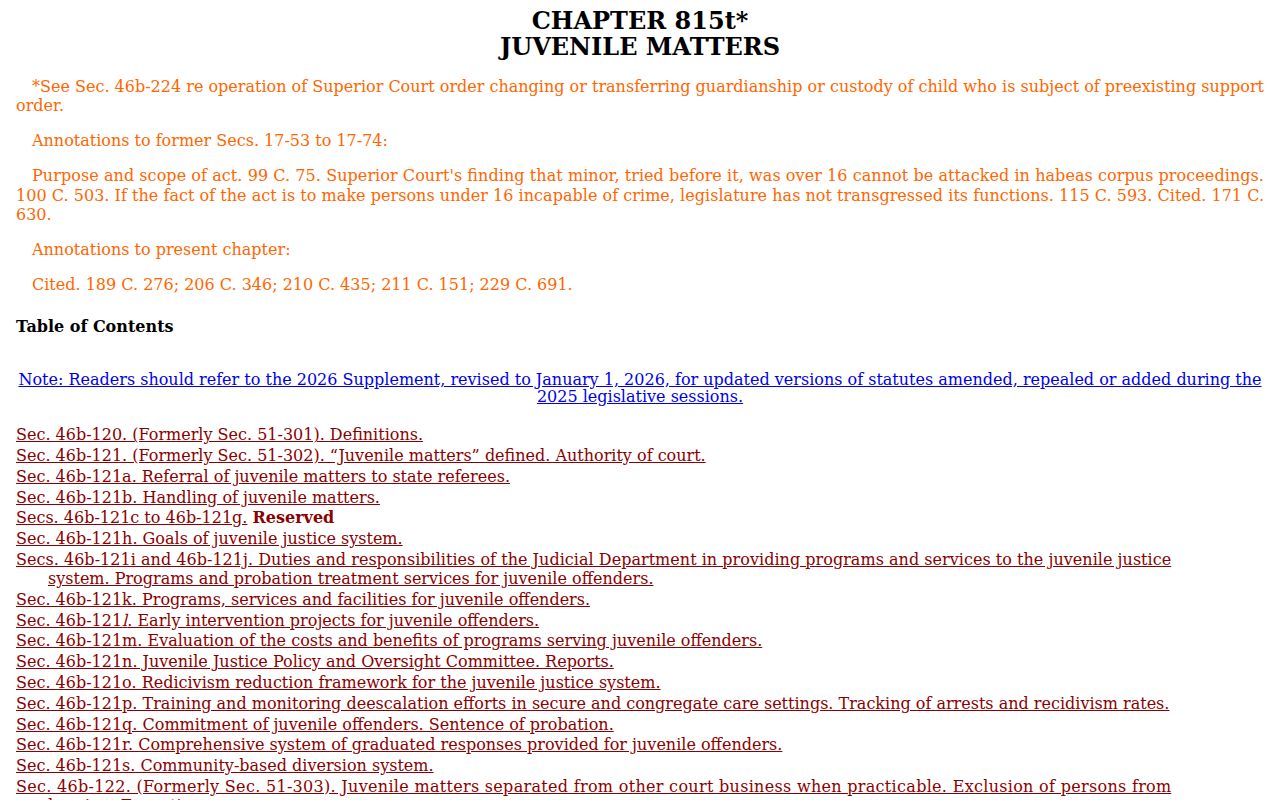
That statutory limit is one reason a public search may omit a record even when an arrest or court event occurred.
Connecticut also uses erasure for many criminal records. If a case ended in acquittal, dismissal, eligible nolle period, pardon, or another qualifying event, Conn. Gen. Stat. Sec. 54-142a may affect public access. For police records, the Milford Police records line or GovQA portal can confirm what is available after sealing or erasure.
A search miss should be read with care. The record may be outside the conviction display period, still pending under a different docket path, restricted as juvenile or youthful offender material, erased by law, sealed by order, or held as a police record rather than a court record. The most reliable next step is to preserve any docket number, charge text, or police report number already known before contacting the clerk or police records staff.